Hanbat National University Researchers Develop a New Predictive Model for Designing 2D Perovskites
PR Newswire
CHUNGCHEONG PROVINCE, South Korea, July 2, 2026
By separating dielectric-screening effects from structural distortion, the study offers practical design rules for tuning excitons in 2D perovskites
CHUNGCHEONG PROVINCE, South Korea, July 2, 2026 /PRNewswire/ -- Two-dimensional (2D) perovskites have emerged as promising optoelectronic materials. However, their practical and rational design is hindered by poor understanding of the relationship between the screening environment and excitonic properties. In a new study, researchers developed a new method to isolate the effects of the screening environment, offering a new predictive model for excitonic properties of 2D perovskites. This will contribute to more stable and tunable optoelectronic technologies.
Two-dimensional (2D) perovskites are promising for next-generation optoelectronics because their alternating inorganic-organic structures offer better stability and stronger excitonic effects than traditional 2D or 3D materials. However, their light-emitting properties are heavily dictated by complex quantum and dielectric confinement effects from the surrounding layers. The exact impact of this dielectric screening environment on excitons remains poorly understood, hindering the predictive modeling and rational design of these materials.
To bridge this gap, a research team led by Professor Ki-Ha Hong from the Department of Materials Science and Engineering at Hanbat National University in South Korea conducted a systematic study to isolate the effect of the screening environment. "To understand what controls the excitonic properties of 2D perovskites, we used a structurally consistent series of organic spacers," explains Prof. Hong. "This allowed us to isolate the role of dielectric screening from structural changes, showing exactly how it modulates the quasiparticle bandgap and exciton binding energy." Their study was made available online in Advanced Functional Materials on December 09, 2025, and published in Volume 36, Issue 30 of the journal on April 13, 2026.
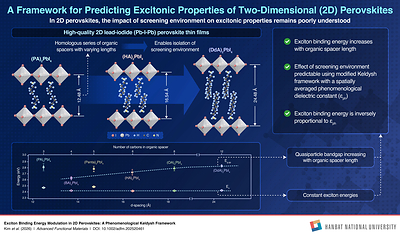
The researchers isolated the effect of the dielectric screening environment by fabricating high-quality 2D lead-iodide perovskite thin films, focusing on an even-numbered series of organic spacers with varying alkyl chain lengths to tune interlayer distance without structural distortion.
Using photoelectron and UV-vis absorption spectroscopy, they discovered that as spacer length increased, the quasiparticle bandgap widened while the exciton energy remained nearly constant, resulting in a substantial rise in exciton binding energy. While the standard Keldysh model failed to fully reproduce this behavior, the researchers successfully matched experimental data by introducing a phenomenological dielectric function that accounts for the finite thickness of the organic spacers, establishing a validated framework for predicting excitonic properties.
"Our model offers a practical design rule for predicting how organic spacer length controls excitonic properties of 2D perovskites," concludes Prof. Hong. "This provides a molecular-level design rule for tuning exciton binding energy and energy levels in 2D perovskites, which can guide future design of light-emitting, photovoltaic, and other optoelectronic materials."
Reference
Title of original paper: Exciton Binding Energy Modulation in 2D Perovskites: A Phenomenological Keldysh Framework
Journal: Advanced Functional Materials
DOI: 10.1002/adfm.202520461
Author Names: Kitae Kim, Namhee Kwon, Sang Woo Park, Wonsik Kim, Seunghwan Kim, Eunki Yoon, Aelim Ha, Donggyu Lee, Young Yong Kim, Jong-Cheol Lee, Sungho Lee, Junghan Lee, Kyu Hyoung Lee, Yeonjin Yi, Ki-Ha Hong, Soohyung Park
About the University
Website: https://www.hanbat.ac.kr/eng/
Media Contact:
Seyoung Jang
82-42-828-8461
417806@email4pr.com
 View original content to download multimedia:https://www.prnewswire.com/news-releases/hanbat-national-university-researchers-develop-a-new-predictive-model-for-designing-2d-perovskites-302816065.html
SOURCE Hanbat National University

