Manufacturers Need Defensible AI Use-Case Roadmaps Instead of More Disconnected Pilots, Finds Info-Tech Research Group
PR Newswire
ARLINGTON, Va., May 14, 2026
Manufacturers do not have a shortage of AI ideas. They have a prioritization problem. As executives, vendors, and operations teams push competing AI opportunities, CIOs and manufacturing leaders need a defensible way to determine which use cases will deliver measurable value, which are ready to scale, and which should be deferred. Info-Tech Research Group's new blueprint, Modernize Manufacturing Operations Using High-Impact AI Use Cases, provides a structured framework and AI Use Case Selector Tool to help organizations evaluate and sequence high-value AI opportunities across planning, sourcing, production, and delivery.
ARLINGTON, Va., May 14, 2026 /PRNewswire/ - Manufacturers are under growing pressure to turn AI from experimentation into measurable operational performance, but many remain caught between the urgency to act and uncertainty about where AI will create the strongest advantage. To help CIOs and manufacturing leaders move from pilots to scalable outcomes, Info-Tech Research Group has recently published its Modernize Manufacturing Operations Using High-Impact AI Use Cases blueprint, a practical resource for identifying, evaluating, and prioritizing AI use cases based on business goals, manufacturing value-chain relevance, value drivers, adoption rate, technology maturity, and overall impact.
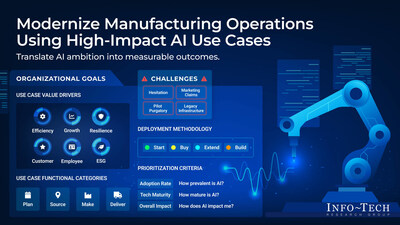
Info-Tech's research explains that fragmented data architectures, siloed decision-making, cultural resistance, legacy systems, and unclear ROI targets often prevent manufacturers from scaling AI across operations. The result is not a lack of experimentation, but a lack of repeatable decision-making. Many manufacturers remain data-rich but insight-poor, relying on backward-looking key performance indicators and isolated proofs of concept instead of real-time intelligence across the manufacturing value chain.
"Manufacturers do not need more AI experimentation; they need a disciplined way to determine where AI can create measurable operational value," says Shreyas Shukla, principal research director at Info-Tech Research Group. "The organizations that will pull ahead will be those that connect AI to measurable business value, embed it into real operational workflows, and govern it as a core manufacturing capability across planning, sourcing, production, and delivery."
Key Challenges Slowing AI Value in Manufacturing
Info-Tech's blueprint highlights several recurring barriers that continue to limit AI adoption and value realization across manufacturing environments:
- Urgency without prioritization: Manufacturing executives understand that AI is becoming essential to competitiveness but often lack clarity on where AI will deliver meaningful advantage first.
- Pilot fragmentation: AI initiatives are frequently launched in silos, with different data sources, tools, success metrics, and governance models, making results difficult to replicate or scale.
- Vendor noise and unclear value: A crowded AI market has created overlapping claims and inconsistent promises, making it harder for leaders to distinguish practical solutions from marketing hype.
- Limited real-time intelligence: Many manufacturers still underuse the data captured from machines, systems, and sensors, leaving operations dependent on manual reporting and delayed insights.
- Trust, talent, and legacy constraints: Operations teams may distrust opaque models, while talent shortages and legacy systems continue to limit the ability to integrate AI into production environments.
The firm's research emphasizes that AI will not transform manufacturing through experimentation alone. Sustainable value depends on strengthening core business capabilities, tying AI investments to measurable outcomes, and ensuring those investments can endure under governance and scale.
Info-Tech's Four-Step Framework for High-Impact Manufacturing AI Use Cases
The Modernize Manufacturing Operations Using High-Impact AI Use Cases blueprint outlines a four-phase methodology to help manufacturers move from AI ambition to a focused, executable roadmap:
Step 1: Discover Objectives
CIOs and manufacturing leaders engage cross-functional stakeholders across the Plan, Source, Make, and Deliver domains to understand end-to-end value streams, operational dependencies, data flows, decision-making processes, and sources of friction.
Step 2: Frame Priorities
Leadership teams define their top organizational goals using SMART metrics and map those goals to Info-Tech's six manufacturing value drivers: operational efficiency, business growth, customer experience, employee experience, risk and resilience, and ESG.
Step 3: Explore and Evaluate
Organizations assess use-case relevance by considering adoption rate, technology maturity, and overall impact. This evaluation helps leaders filter out speculative ideas and focus on opportunities that are strategically meaningful and practical to pursue.
Step 4: Plan Next Steps
Teams validate recommended use cases across the manufacturing value chain and begin building an AI roadmap aligned with organizational objectives, readiness, prerequisites, and expected business outcomes.
The blueprint is supported by an AI Use Case Selector Tool that helps manufacturing leaders assign weights to value drivers, define organizational goals, map those goals to measurable outcomes, select filtering criteria, and review recommended use cases.
Info-Tech's Modernize Manufacturing Operations Using High-Impact AI Use Cases blueprint also advises manufacturers to consider AI deployment maturity when building their roadmaps. Organizations may begin with readily available tools and lightweight retrieval-augmented generation, buy commercial platforms with embedded AI capabilities, extend existing systems with custom workflows or low-code tools, or build proprietary AI models and MLOps capabilities where differentiation justifies the investment.
By applying the firm's framework, CIOs and manufacturing leaders can identify quick wins such as predictive maintenance, defect detection, and spend analytics while building the strategic foundations needed for longer-term transformation. The blueprint positions AI as a core operational capability that can strengthen efficiency, resilience, quality, and innovation across the enterprise.
For exclusive and timely commentary from Info-Tech's experts, including Shreyas Shukla, and access to the complete Modernize Manufacturing Operations Using High-Impact AI Use Cases blueprint, please contact pr@infotech.com.
About Info-Tech Research Group
Info-Tech Research Group is the "get things done" partner for over 30,000 IT, HR, and marketing leaders worldwide. The fastest growing research and advisory firm, Info-Tech enables leaders to make well-informed decisions and transform their organizations through AI, strategic foresight, step-by-step methodologies, practical tools, industry-leading advisory, and training programs. For nearly 30 years, tens of thousands of private and public organizations have trusted Info-Tech to lead their most important initiatives through periods of change and deliver outcomes that truly matter.
To learn more about Info-Tech's HR research and advisory services, visit McLean & Company, and for data-driven software buying insights and vendor evaluations, visit the firm's SoftwareReviews platform.
Media professionals can register for unrestricted access to research across IT, HR, and software, and hundreds of industry analysts through the firm's Media Insiders program. To gain access, contact pr@infotech.com.
For information about Info-Tech Research Group or to access the latest research, visit infotech.com and connect via LinkedIn and X.

 View original content to download multimedia:https://www.prnewswire.com/news-releases/manufacturers-need-defensible-ai-use-case-roadmaps-instead-of-more-disconnected-pilots-finds-info-tech-research-group-302772454.html
SOURCE Info-Tech Research Group

