Nation's innovation strength, speed hailed
PR Newswire
BEIJING, June 17, 2026
BEIJING, June 17, 2026 /PRNewswire/ -- A news report from China Daily: China's accelerated efforts to foster new quality productive forces are injecting fresh momentum into innovation-driven growth and creating broader opportunities for multinational companies seeking to deepen their presence in the world's second-largest economy, business executives and economists said.
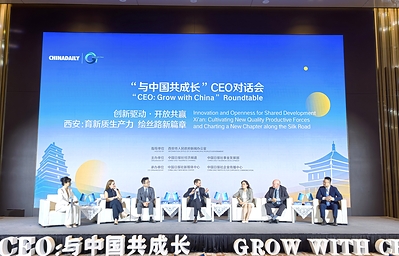
Xi'an, Shaanxi province, known as the starting point of the ancient Silk Road, is emerging as a key inland innovation-driven hub, they added, as its strengths in technological research, advanced manufacturing and international connectivity play a growing role in China's pursuit of high-quality development and high-level opening-up.
They made the remarks on Tuesday in Xi'an during the "CEO: Grow with China" roundtable, which was hosted by China Daily under the guidance of the Xi'an Municipal Government.
"What is now shaping China's development is the shift toward new quality productive forces," said Raquel Ramirez Alexander, vice-president of the European Union Chamber of Commerce in China and chair of its Southwest China Chapter.
It reflects the country's transition from growth driven mainly by scale and investment to growth increasingly powered by technology, productivity gains, digitalization, sustainability and advanced manufacturing, she said.
China offers increasingly diverse opportunities, she added, citing a survey jointly released recently by the chamber and consultancy Roland Berger, which showed "signs of an uptick" in confidence among European businesses operating in China, while also pointing to expectations for further improvements in the business environment.
Zhu Guangyao, former vice-minister of finance, said in a video address that China's continued push for high-level opening-up and a better business environment will provide a stronger foundation for multinational companies to grow in the country, adding that their long-term engagement in the Chinese market has also helped advance China's industrial upgrading and economic development while benefiting themselves.
"China is not just an important market. It is also a place where the future is taking shape very quickly," said Rogier Janssens, president of the China unit of Germany-headquartered Merck, in a video address.
"You can feel it here. The pace is fast. The ambition is high. More and more, we see innovation being turned into real impact," Janssens said.
Echoing Janssens' view, Simon Lacey, founder of Market Access X, an international trade and market access advisory firm, said his confidence in China over the next five years comes less from the size of its market than from the pace of innovation.
He said what is difficult to replicate elsewhere is the speed at which products are iterated and improved in China, supported by the country's strong research and talent base.
"If I had to put China's importance in one sentence, it has gone from the place you went to make things cheaply to the place you have to be to stay at the frontier," Lacey said.
That shift, economists said, is ultimately about more than innovation itself. It is about the ability to turn technological progress into stronger industrial capability.
David Blair, vice-president and senior economist at the Center for China and Globalization, said the deeper integration of manufacturing and innovation will be key to future competitiveness.
AI and other new technologies have the potential to significantly boost productivity, but their broader impact will depend on how effectively they are applied to manufacturing, he added.
This is also putting greater emphasis on enabling technologies, such as photonic technologies, that can support the next stage of industrial upgrading.
Mi Lei, founding partner of Casstar, said photonic technologies will play an increasingly important role across the information industry, from data acquisition and transmission to storage and processing.
Photonic chips are expected to become core infrastructure in the artificial intelligence era and continue to drive a new wave of industrial upgrading, he said.
For multinational companies, this focus on moving innovation into production is already being reflected in deeper local operations.
Maria Zhang, general manager of Mubea China, said the company's China operations have moved well beyond assembly and sales over the past five years, with its plant in Changzhou, Jiangsu province, now co-developing new machine configurations for global markets.
For the German machine tool manufacturer, China has become its "largest laboratory for advanced manufacturing solutions", reflecting the country's growing role as a source of intensive, fast-paced innovation at scale, she said.
Mubea is not alone in stepping up its China presence. US company 3M has also seen China become its largest overseas market, said Henry Ding, president of 3M China, in a video address.
In recent years, 3M has accelerated the localization of its full value chain in China, spanning research and development, testing and manufacturing.
"This year, 3M China will continue to increase its local R&D investment and plans to achieve more than 30 percent growth in new product launches compared with 2025, significantly outpacing other global markets," he added.
Buoyed by confidence shared widely among global businesses, Xi'an, the host city of the roundtable, is moving quickly to capture opportunities created by China's push to develop new quality productive forces, drawing on its strengths in technological research, advanced manufacturing and Eurasian connectivity.
The city's role as an inland innovation hub is particularly visible in aviation, one of its pillar industries and a key area linking advanced manufacturing with international cooperation.
George Xu, executive vice-president of Airbus and chief executive officer of Airbus China, said in a video address that Xi'an is a strategic center for China's aviation industry.
He said Airbus' cooperation with Shaanxi province has deep roots, noting that the wings of every A320 family aircraft delivered in China are supplied by the Xi'an Aircraft Industry Group of the Aviation Industry Corporation of China, or AVIC.
"AVIC Xi'an Aircraft Industry Group has become one of Airbus' largest suppliers in China," Xu added.
"Xi'an's highly integrated ecosystem spanning industry, academia and research offers companies a faster route from basic science to commercial application," said Arthur Huang, a member of the Expert Committee of the China Chamber of Commerce for Import and Export of Machinery and Electronic Products and president of CarbonNewture.
Sharing a similar perspective, Edward Hu, country president of International Workplace Group China, said what impressed him most during his visit to Xi'an was the strong convergence of high-tech industries and a deep talent pool supported by leading local universities.
"Xi'an serves as the eastern gateway of a corridor that is reshaping economic links across the Eurasian interior," said Lacey.
The city's rise, he said, is creating more durable opportunities for businesses across western China and the wider region.
 View original content to download multimedia:https://www.prnewswire.com/news-releases/nations-innovation-strength-speed-hailed-302803784.html
SOURCE China Daily

